Showing posts with label adafruit. Show all posts

Saturday, 11 June 2016

Project Snowflake - A 3D printed LED Light sculpture

* Project Snowflake *


This project started Christmas 2015. Whilst searching with my daughter's for some nice models to print out during the Christmas break, we found the great Electra modular origami by Auntdaisy. That seemed like a good challenge.

Below is a video about Project Snowflake, you can also watch on YouTube in HD and subscribe to my channel if you like.


For some background this project started because of a great modular Origami system called Electra. Designed by AuntDaisy - Link >  Electra Modular Origami by AuntDaisy


Below is an extract from the Thingiverse page for Electra - For further information about Electra or more models by AuntDaisy, follow the link above -

MakerHome blog showing how this model was created - see - http://makerhome.blogspot.co.uk/2014/07/day-327-saturday-guest-auntdaisy-and.html

For more information on David Mitchell's origami design, seehttp://freespace.virgin.net/dave.mitchell/galleriesmodulardesigns.htm or his latest "Paper Crystals" book, http://www.amazon.co.uk/dp/0953477495 (with lots of other exciting models.)
_______________________________________________________________________________

For this project we used a string of waterproof WS2811 LED's from China for under $20US


You can cut the chain or add more. Each led has a Red, Green and Blue led, along with a driver and shift register - that also does clock reshaping, so in theory the number and length can be rather a lot of LED's. In reality I would stick to under 200 per chain as the current needed to drive them an the length starts causing issues.

If you need more, just use two strings and control the sequence on the Arduino.

And it's very simple to drive these LED strings with just one Digital output from any microcontroller (5v I/O recommended) - see the adafruit library or use my daughter's example code as a starting point (it's based on the adafruit examples).


The adafruit Uberguide to Neopixels is really all you need to get going with these great little LED's


Many different displays are based on these great LED's - Just search eBay for WS2811 or WS2812 for lots and lots of options.


Wiring is straightforward - 

You need an Arduino compatible board - The adafruit flora or gemma is great for experimenting with Neopixel's and if even has one already fitted to the board.

Neopixels like a 5V digital I/O signal, so a good option is the Arduino Nano.


The Arduino micro can also be used but you will need to also add a 5V regulator - 


If your voltage regulator has a tuned output, then make sure you set it to 5V before connecting it up to the Arduino mini (or any other Arduino without an on-board regulator) - or you will fry it.


The LED string we used runs on +12V so with the Nano we can connect the +12v directly into the power input.


 The Nano can be bought in 3.3v and 5v versions, do check you buy the 5v model.


The Nano is a great little board, even with an onboard USB connector for programming.


Also make sure your power supply is +12V at around 2Amps or more.


Also it's a very good idea to add a 100uF capacitor (rated at +16V or higher) to the Power supply Output, then you can connect that to the power input on the Arduino Nano.


The only other component we need is a 220Ohm to 560Ohm resistor (the one above is a 510Ohm)


You can accidentally damage some Neopixel style WS8211/12 LED's if you don't fit a resistor in series with the first LED. It needs to be connected to the output pin (here we are using Digital 8) and then into the Input of the WS8211 LED string.


The string of LED's run one after the other, Blue is ground, Red is +12V and the input and output is White. Make sure you connect the output of your Arduino Digital 5V I/O pin (D8) into the Input (shown on the left in the image above).


Then you can fit each LED into the 3D printed modules, if they are a little tight, heat the plastic slightly with a hairdryer - they should click in and stay firmly fitted.
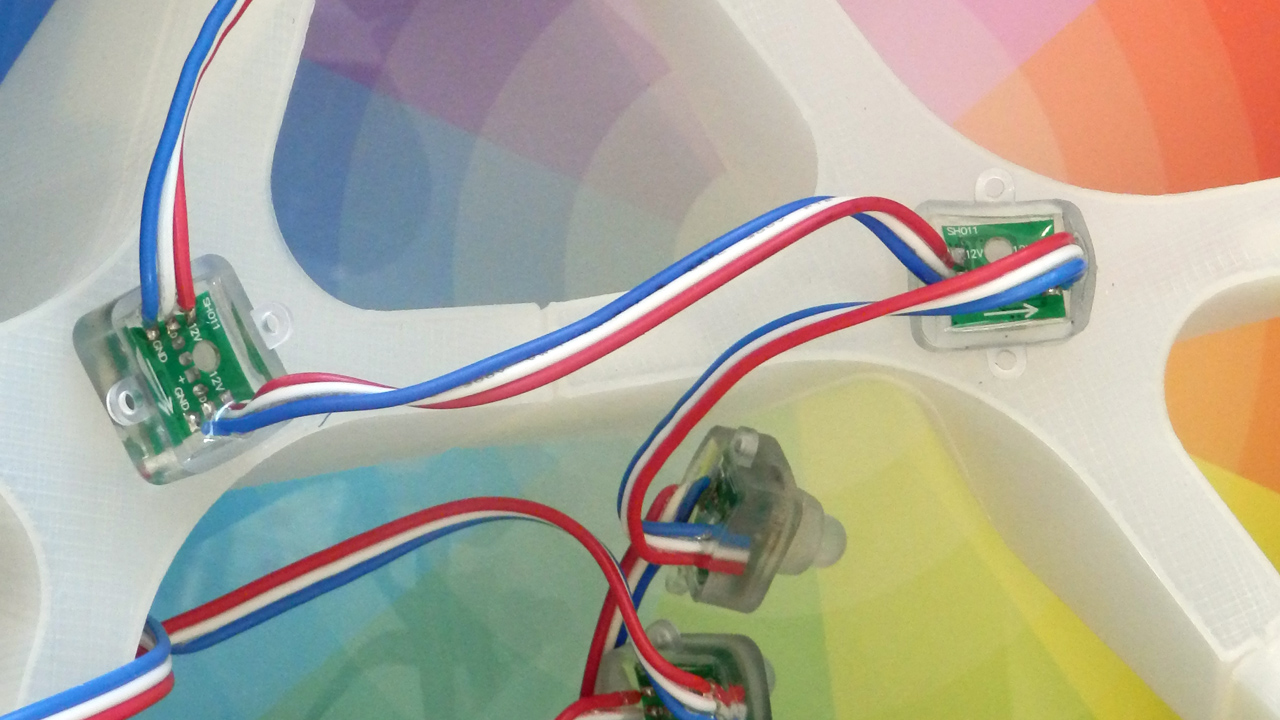

It's best to route them in a spiral, you can only really do it one way making sure all 30 holes are fitted.


Leave as many other LED's as you like in the chain, they would look cool hanging down or up if you are going to hang the sculpture from a rope for example.

We had a chain of 35.

This was a great learning project for and with my Daughter (10 years old).

Last year she assembled a RepRap Fisher Delta 3D printer, so this was an natural progression, Doing the 3D model design in Freecad.


Then building up the electronics and wiring the modules.

And finally programming with the Arduino IDE.

She really enjoyed it, and is already doing more projects, and investigating more uses for 'Neopixel' style LED's.


That's it!

All the files are over on Youmagine here, along with the model file to 3D print and example code for the Arduino nano to drive the LED's and some other files to experiment with the adafruit Flora.

I almost forgot to mention, I found a really great plastic filament from Excelvan for using LED's - Light piping and diffusion - it's really nice to use and perfect for any sort of LED based projects.


Please watch the video if you want to see it in action, and if you have any questions just leave a comment, or ask me on Twitter / G+ or YouTube.

Twitter - @Richrap3d
Google+ - RichardHorne_RichRap3D
YouTube Channel RichRap

Until next time, happy printing.

And if you decide to print out Project Snowflake, please let me know.

Rich.


Friday, 6 June 2014

Makerbot Patents and the Open Source 3D Printing community

MAKERBOT * PATENTS * TRUST

I was just about to move on, thinking the message was clear and enough was said on the Makerbot Patents, trust and treatment of the Open source 3D Printing community debate, when a Google+ Post popped up from Eddie Kay 3DPrintboard.com . (One man's defense of MakerBot's patent filings. ) What do you guys and girls think?) That pointed to a post here -

I'm all for defence and debate, it made me document a few more things below on this topic -

I'm not 100% sure if the poster Dragons_Blood and Eddy Kay on G+ are the same person? feel free to let me know, I would be happy to discuss this further if needed.


I just had to reply on this, here on my blog - The points and my reply in blue to them below -

From the points on 3DPrintboard.com -

Dragons_Blood - “I just wanted to let my voice be heard. I'm not a huge fan of Makerbot but I don think that what they are doing is not exactly their fault.”

RH - Who’s fault is it? Is someone holding a 3D printed gut to their heads? Using a broken system is not an excuse.

“Makerbot has 2 choices here. Either patent these designs which aren't already patented, or allow another company to do so. “

RH - Other choices include, releasing the exact same documentation you use for the patent out into the public domain as Prior Art, and then happily manufacture these designs. This can be done directly or by allowing the Patent application to lapse, then it becomes Prior art and no one can then patent, but anyone can use the idea / method.

“If another company patents these designs, then they can prohibit Makerbot from ever using them on any of their future 3d printers. However, if Makerbot patents them, they ensure that another competitor (i.e. 3d systems with cubify) doesn't patent it and hold them out of the market. “

RH - See above about public domain and prior art.

- Most of the open-source and maker community is not concerned about companies fighting over patents, infringements and IP, that’s their choice for constantly going down that route.
- What would have made all the difference is if Makerbot made a statement saying they will not go after anyone in the open-source community, or designers where inspiration for these types of ideas also appeared. The fact they have patented so many interesting aspects of Home 3D printing that are also being developed in the open-source community and that they have not engaged at all with that community on this aspect, means they want ownership of patents covering these things, and they didn’t want to highlight what they were doing ‘in the background’. Many companies face this ‘big business problem’ that’s fine – it’s clear that Makerbot is not going to stop down that route, they have stated many times now “we need strong patents” – the concern is over what they intend to do with them and that they have not been open with an open-source community they once held closely at the heart of their business model.

RH 
{
-          RedHat (another very big company) also built on Open-source – Do indeed make a Patent Promise - http://www.redhat.com/legal/patent_policy.html

-          Over on Google+ if you search you will find an this post from  who claims he offered to assist Bre Pettis (Makerbot) over a year ago with similar type of promise to the ‘community’ – I find it a real missed opportunity that was not taken up or used as a guide for a similar statement from Makerbot – if it had, this would not have caused such a bad feeling of betrayal and brocken trust within the open-source/RepRap community and Makerbot’s patents.

Jan's G+ Post - "Dear +MakerBot , here's an idea for you to ponder. Take a look at http://www.redhat.com/footer/patent-promise.html The Red Hat Patent Promise. To put it in simple terms, we at Red Hat apply for patents, mostly out of defensive reasons in a world of patent trolls. But we are fully aware that we must defend the freedom of Open Source and Open Innovation. So we have the legally binding promise that we will never use our patents against developers of Open Source software. It's not the perfect solution, but it is definitely better than your current approach of filing patents and not declaring what the community can do or NOT do.

A year ago I offered +bre pettis my help in working on a similar approach for Makerbot, this however never happened. I am still ready to help and hook you guys up with my network. I think you could have avoided a lot of negative vibes with a patent promise in the Red Hat style."

-          Pledges like the RedHat Patent promise not to go after open-source contributors to a project / technology are already being used by companies that need to have strong patents for legal defence, but also do not want to alienate a community that supports them and can often lead to ideas worth patenting.

-          Without this sort of statement, what are people to think? How will Makerbot use their power and Patent arsenal? For or against an open source community or open-source company? Who knows, but waiting to see is going to be too late.
}

“If that were to happen, it would be very difficult for MakerBot to do anything about it. “

RH - Companies design around patents all the time, and produce more innovative products in the process, also producing more IP that can then be opened up or kept secret, whatever works for you.

“I highly doubt that Makerbot plans to use these patents to profit off of, or keep anyone from entering the market. They are doing it simply to protect their ability to use these currently unpatented designs in the future. “

RH - Why would you assume that? One of the only reasons to have a patent it to get some leverage from it, by making someone else afraid to go near your patented method in-case they say you infringe. Or to attack someone (a competitor doing quite well in the market, but not well enough to defend a big legal battle). And then also to have a patent armoury as a final card to play if someone comes after you.

“Right now they are all free to use, since there are no patents on them. However, if Cubify (3d systems) came along and patented them, they could hold MakerBot ransom. “

RH - Ransom, Threat, Stalemate, stand-off, war, stranglehold, limiting innovation that's what patents have come to stand for. You can decide to patent almost anything, if you have enough money and think it will benefit you.

“Sure Makerbot could go to the courts and say that these designs were created by someone else but then that other person may be required to either patent the design or allow someone else to. They would be stuck in a catch 22, where the patent would either belong to the company that filed the patent, or the original filer, who may not even wish to file a patent for the design. “

RH - The Patent system was supposed to stop things in the public domain being patented in the first place; the scenario above will always appear if companies decide to gather as many patents in an area as possible with the intention of patent litigation in the future.
Most patents are vague for the very reason of letting some later process in the courts or by expert testimony win over an infringement claim, or so simply sink the other party in legal debt before the case is finished.

“I think Makerbot is getting too much heat for just protecting their future business model. Until we see them actually sue someone for using these designs, I think we should let them be.”

RH - It’s too late once they sue a growing open source company - who will already be on their radar - like Printrbot, Ultimaker or RepRapPro for Patent infringement, what they could have done is make a Patent promise not to go after these types of open-source companies in a similar way to how Red-Hat handled their growth. That’s the true missed opportunity to unite a now big company like Makerbot with an entire (and very smart) community to forge trust, rather than shatter and divide it.

RH - That takes true vision and courage, Bre Pettis could have pulled it off if that’s what he wanted to achieve with Makerbot and the wider 3D Printing community. That’s what I'm personally disappointed about.

__________________________________________________________________________


Other posts have appeared over the last week on the Makerbot Patent/trust storm, including some high-profile sites shining a big spotlight on the debate.

Cory Doctorow Posted over on BoingBoing - It's way more balanced than many posts on this subject and raises some fair points for debate, unfortunately I think we have seen the direction Makerbot has decided to take, so we may never see them reach out to build back any trust with the Open source community. And as Cory states, head over to Adafruit to buy a LulzBot TAZ 4 open-source #RepRap 3D Printer 


Even Adafruit themselves do not seem to be able to decide if they want to stock Makerbot/Stratasys products.

John Biggs on TechCrunch posted The Next Open Source Battle Is Being Waged In The 3D Printing Industry
John does mentions Red Hat, but unfortunately not the point about a patent promise I talked about above.
  
Makerbot finally released a statement, (here on TechCrunch) it's bland sees right past the issues of trust and duplicity with the 3D printing community. 

The arguments could easily rage on back and forth, If Makerbot only want to focus on the Quick-Release Extruder - Members of the community have highlighted extruder designs that have the bistable spring implementation posted to Thingiverse as early as 2011 http://www.thingiverse.com/thing:7129 "by MiseryBot, published Mar 19, 2011" Not quite as "slick" but it does have that key "bistable" bit. Makerbot, I feel you are now on your own.

Plenty of other comments and views are also being aired all over on various forum's and blogs, 

Jeremie Francois Posted his thoughts and opinions here


The sun is shining, and I have real 3D printing to do, so the next Blog post will be a return to all things RepRap. Promise.

Thanks for reading, it was rather a lot of text.

Rich.