Wednesday, 28 May 2014

Makerbot Patents twist the knife on open source 3D Printing roots, community responds.

Something is leaving a bad smell in the Open source community, could it be the recent Patents of big cheese Bre at Makerbot.

It's always very sad when you see a company or group turn their back on whatever community or project that helped make them successful.

Makerbot seem to be traveling down a darker and darker road as time goes on. I'm not sure if they felt invincible or that no one would notice but a recent patent frenzy by Makerbot has angered the open source 3D printing community. And we don't yet know what more is to come.

I prefer to use this blog to document work and talk about good things, so this is really a summary of past and recent events and links for you to find out more and make your own mind up about Makerbot's actions and community reaction to these disappointing and Machiavellian maneuvers.

And before we go on, I am not against Patents, they can be used for good to protect ideas and costly investments into research, that for some is a necessity to fuel sales and marketing of a product or invention. I don't think they are very fair and certainly not appropriate in many (most) cases, but they are not going away any time soon. For this trade off of hard work you can exploit an idea under a patent for a set period whilst also disclosing information about the invention and use.

Yes, RepRap and many open-source developments were built on expired patents. That's how it's supposed to work. A company gets 25 years to exploit it's patented invention, if after that time the market demand is still there and competitors can build a better mouse trap, then competition usually kick-starts another industry cycle and one could argue the original patented idea was not exploited well enough or the market was not satisfied with just one source of mouse trap.

What angers individuals is when ideas and developments that were in the public domain, very often with a specific open-source license are taken and patented by a company so others automatically now infringe. (or could be accused to infringe).

Patent trolling or this is abuse of the patent system is about as insulting as you can get to a community that encourages open innovation and sharing of open source developments.

Companies that can afford to mop-up open innovation into hundreds of patents, loosely based on ideas common in an industry or sector often have the power to legally threaten anyone that becomes a competitor. Using this abuse of the patent system can tie up smaller companies and stop new developments from even starting due to this sword of damocles handing over head.

Many things are just not worth patenting for companies or individuals, due to the cost and return possible along with the ability to be able to defend your patent if required. But if these seemingly insignificant ideas are patented by bigger companies who can afford the process, as a way to expand their patent portfolio, even if they were not 'invented' they take on another form of power.

Makerbot did 'invent' and patent an automated build platform, this was a commercial failure and proves the point not all ideas are worth patenting. Also the idea of an automatic build platform was openly discussed by various people when I first joined RepRap, long before the Makerbot patent, the difference here being that no one found it useful, practical or in any way essential, so the news Makerbot patented it was just not such of an issue.

Recent turbulent Thingiverse/Makerbot history - 
Back in September 2012 changes to the Thingiverse Terms of Service along with various concerns that Makerbot was moving away from it's RepRap and Opensource roots led to an Occupy Thingiverse campaign.

This was exactly what Thingiverse looked like on 20th September 2012 -


It was the Same day Thingiverse decided to promote and feature my 3-way colour mixing extruder. (And it had already been on Thingiverse and my Blog for 28+ days before this) - See image below 'Created by RichRap 28 days ago'


And the very next day after on the 21st September 2012 they filed a patent for build material switching.

Along with my 3-way multi-input material extruder above, I also posted, documented and shared my simple solution using lengths of different materials to produce multi-coloured objects - that was back in June2011.

Makerbot want to patent various things to do with multicolour and multi-matrial mixing, much of which has been done and documented in the open source community (Even directly at Bath University - UK as early as Feb 2012 and mentioned on the RepRap Blog June 2012 - Myles corbett report) This, over the last few years and is a very active area of open-source 3D printer development for myself and many others.

Plenty of other patent applications are also being submitted, we can only see the ones that have been published, so who knows what other things are in the pipeline...

Many of the recent Makerbot patent applications can be seen and read on this site here - You can search for Makerbot, or click on this search link here 

Title - BUILD MATERIAL SWITCHING
Abstract - A three-dimensional printer uses transitional lengths of build material to facilitate changes from one color to another during a fabrication process, and more generally to achieve multi-color objects corresponding to color patterns on the surface of a three-dimensional model. The transitional lengths of build material may be positioned inside a fabricated object, such as for infill, or outside the fabricated object where undesirable aesthetic properties of the transitional lengths will not impact the desired distribution of colors on the surface of the fabricated object.

Title - COLOR SWITCHING FOR THREE-DIMENSIONAL PRINTING
Abstract - By reversing the direction of a first build material fed into an extruder, the first build material can be wholly or partially evacuated from the extruder before a second material is introduced. This approach mitigates transition artifacts and permits faster, more complete changes from one build material to another.

A founders Perspective - 
A day later after the 2012 Occupy Thingiverse - Zach Hoeken posted his view of the changes he observed to Makerbot here-


Makerbot Patent Rage Coverage - 

OpenbeamUSA has one of the best overviews of recent Makerbot patent troubles, it's well worth a read, and I don't need to repeat things here - Stay classy, Makerbot

This also contains the details of how you can file a prior art application to help block a patent that is based on someone else's work or in the public domain.

Another good summary of the Quick Release Extruder Patent Here - 

Hackaday.com covered - makerbot files patents internet goes crazy 

Fabbaloo Posted - Has MakerBot Crossed The Line? For Some, Yes


Edit:- Added more coverage -
3deee.ch Makerbot Vs Open Source

TechDirt - MakerBot Files For Patent On A Design Derived From Work By Its Community


Please discuss, share and the tag #TakerBot seems to be being used by people - 

Visual guide graphics below courtesy of Anthony Clark.


If you are now looking for a place to share, YouMagine is a very good starting point.

GitHub is also an option, and a simple method to export all your things from Thingiverse uses a simple Python script by Carlos García Saura - Look Here for info.

Repables is also looking good for content sharing, and is being further developed right now.

Ultimately work like the Thing Tracker Network, by Gary Hodgson may make it easier to link and share designs and models from almost any source, so don't stop sharing and keep it open source.
 If you see any other coverage on the Makerbot Patents, post links below. Thanks.

Other news - 

The 3D Printing Filament spool standard campaign is still going well, updates soon.

E3D Just released the V6 hot-end -I have had one for a while -  it's amazing !

++Lots++ of new things to share with you soon, new printers, extruders, developments and materials :) So long as people don't take them and patent the work as their own...


Rich.

Thursday, 13 March 2014

Universal 3D printing filament spool standard 2014

One spool to rule them all...


Coils and coils of lovely 3D printing filament, I'm usually surrounded by them, I struggle with them and often spend time and energy mounting, clamping, switching and feeding them into to various printers.

There has to be a better way. (lets please all find a better way)

* The problem *

Every single one is different, bare coils or reels, some are even different from the same manufacturer.

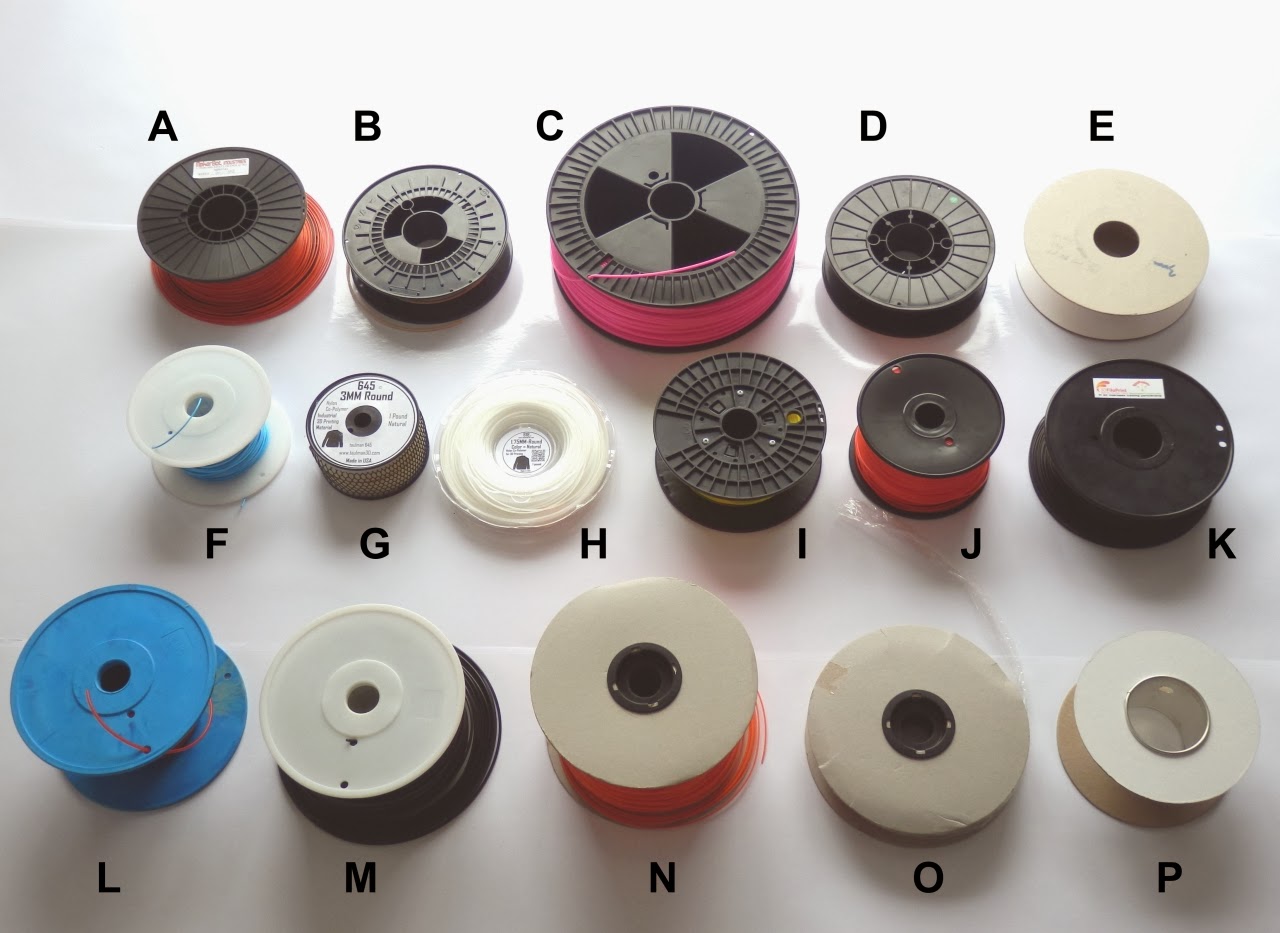
Just to point out here, this is only a tiny selection of 3D printing filament reels available, these are the ones I happen to still have around me. Even the long list on RepRap.org of filament suppliers is a fraction of what's actually available.

Loose coils of filament are both great (no wasted spool or extra cost to ship packaging) and also the work of the devil. You usually need to cut a random shorter length of coil off, just so you can use a section of material in a sensible way, or run the risk of getting into a tangled mess of coil and printer. You then risk not having enough material to finish the print, something that seems to happen more often than I would like.

Once when trying to use a 750gram loose coil of 1.75mm material (about 300+ meters) I had a tangle so bad the extruder pulled an entire shelf down onto a laptop below, smashing it, bending rods on the printer and also messing up a very nice print. I had mounted a home made spool holder to the shelf above the printer in an attempt to use loose coiled filament. My 20 euro coil of filament cost me over 400 in damages, I didn't do that ever again.

After a lot of messing about with making my own 3DPrinted spool holders, printing other peoples, making them by hand and using various mounting systems, I resorted to using a rack as shown above. It looks ugly, the filament gets dusty and problems like tangles still happen. But as I can't find a really good solution for various printers, this is the best I have.

The closest thing we have to a 'standard' reel is based around the use of 3mm plastic welding rod/coils for automotive repair industry, these very large coils have been used with 3D printing for many years. They have a lot of benefits, but also plenty of negative aspects. Mostly being heavy and big whilst also using more than 300g of ABS to make each one.

Recycle, Recycle- 

One of the reasons I would like to see a spool standard is that I would also like to see less waste from 3D printing, and a way to recycle items like spools and packaging.

A few manufacturers like Josef Průša have already looked at cardboard, producing filament already on lightweight recyclable spools.
In this case the center mounting hole is rather large. The inner coil diameter is big enough not to cause the filament to be too tightly wound.

Dense or corrugated cardboard what would be best?

One of the very first filament orders I ever made came on cardboard spools, since then it's all been plastic of one form or another.

Lets take a look at some filament supplied on reels -

And lots of loose coils of filament too -

Ident
Make / manufacturer
Outer size diameter
Inner coil diameter
Mount hole diameter
Notes
A
Makerbot 1.75mm (1Kg)
202mm
92mm
51mm
Makerbot seem to have a new bigger spool? Can anyone confirm details.
B
Colorfabb 1.75/3mm (750g)
200mm
105mm
53mm
Now using a clear ABS reel (same dimensions)
C
297mm
215mm
52mm
‘Industry Standard’ 2.2Kg (1)
D
200mm
103mm
52mm
ABS for Up! printer
E
Prototype Cardboard
215mm
100mm
53mm
(not in production)
F
160mm
50mm
31mm
Manufacturer unknown
G
Taulman3D Nylon
127mm
50mm
19mm
Mini Spools
H
Taulman3D Nylon
195mm
80mm
none
Old style packets
I
190mm
103mm
38mm
Various reel types used by eSunPLA
J
160mm
58mm
31mm
mini reel
K
202
78mm
52mm
new reel? (conductive ABS)
L
Unknown from eBay
200
79mm
31mm
2.5Kg spool
M
200
79mm
31mm
2Kg spool
N


5Kg card spool
O
220mm
72mm
32mm
1Kg card Spool
P
177mm
75mm
74mm
Metal/Card ~800g spool
Supplied
as Loose Coils


Q
320mm
230mm
N/A
Coil 3mm filament
(100M / ~800g
R
320mm
270mm
N/A
Coil 1.75mm filament (100m / ~260g)
S
420mm
340mm
N/A
Coil 1.75mm filament (750g)
T
Hang on, that’s the same
image
as
H
Correct - It is…
U
185mm
130mm
N/A
Polycarbonate / also using spools now.
V
Unknown from eBay?
Worst
filament
ever
Can’t remember
W
175mm
140mm
N/A
Via 3Dfilaprint
X
210mm
150mm
N/A
Via Orbitech
Y
190mm
120mm
N/A
Via Orbitech
Z
200mm
140mm
N/A
Via Orbitech

(1) - These large ‘Industry Standard’ 2.2Kg spools were first used in the plastic welding industry, it's the closest thing we have to a standard.

I looks like both 30mm and 50mm mounting holes appear in many different reels, that's something 'standard'

Lots of different spools in lots of sizes - the odd looking one (middle left) is an example (one of many) of a 'home-made' spool to help make loose filament less of a pain to use.

The Question ?

Would it be possible for manufacturers to have a set filament standard for spool size, shape and mounting? Can the 3D printing community help develop that standard?
Can we make it Eco-friendly and recyclable?
Does anyone want it?
Lets find out.

Making the 'perfect' spool has a number of challenges - 
  • The inner coil diameter needs to be appropriate for the type of material and size being wound.
* Bad Spool *
3D Printing filament is not like coils of wire, don't try to cram as much as possible onto a spool.

This is 3mm semi-translucent PLA, you can clearly see the bruising of the filament as it's very tightly wound around a 50mm diameter core. The last 1/3 of the spool contents are useless due to being deformed and much too tight to feed into an extruder resulting in really nasty things like lifting the entire Z axis away from the object being printed.

This started to fail before the last 1/3 of the spool, due to pull-back and carriage lifting. Lower quality prints are also often observed during the second half of a 3mm spool this tightly wound.
  • Spool mounting diameter - Some physical resistance is good for spool mounting. Quite often a printed spool holder is used to mount the reels of filament, many different sizes force users to produce smaller diameter mounting rods in an attempt to be able to mount different types, often resulting in noise and rocking around as the spools unwind. Currently one size does not fit all.
Illustration of Inner diameter, Outer diameter and mounting.
  • Width of spool and overall outer dimension is also important, but more in deciding how much filament is required for each spool.
We have seen a trend is supplying less filament per coil over the last few years, We started at 2.3Kg reels used by the Automotive plastic welding industry, then slowly manufacturers moved to a 1Kg reel and many now supply 750g or 500g per single reel. 

Length of coil is also used by some manufacturers, often 100M of either 1.75mm or 3mm material is a 'standard' length supplied. Many manufacturers are now also offering 50M coils often targeted at retail outlets or as a way to try out new materials and colours.

That's all quite a challenge for a standard spool, but if we were flexible on the width and possibly had two outer dimensions it would be possible to make a standard more people could easily use and manufacturers could implement. Just as important is the ability to design them into new and existing 3D printers.
  • Print material - to some degree defines the minimum internal coil size. 1.75mm material can be wound in a tighter coil and materials like Taulman Nylon or Recreus FilaFlex are both so flexible they can be wound very tightly with minimal impact on the ability to print with them.

  • Nylon's, flexible and PET materials also have a tendency to try and unwind from their coils so a bigger inner coil diameter could also help them be less likely to loop and get tangled.
Cost - 

Another major factor will be cost of the spool and any packaging. reducing weight is good for shipping costs and making it from materials that can be easily recycled really needs to be a major goal.
Plastic spools used today cost under $1 and in reality customers are not likely to pay a great deal more for a standard spool? but how much and can a robust spool made from materials like strong cardboard be viable?

Ideas - spark more ideas - 

We now have dimensional information above on some of the types of spools and coils available, and to get the ball rolling here are some simple ideas for filament spools I have been thinking about.

We can see that many reels already have a 50mm mounting hole diameter, so this looks like a reasonable starting point, Both the Ultimaker and Makerbot Replicator use a 50mm spool mount.

The inner inner diameter, bigger is better, but you need to allow enough room for filament without also having a very large outer diameter. A size of around 120mm for the internal seems to work well for most types of plastics and filled materials in both 3mm and 1.75mm sizes.

A diameter of 220mm for the outer will allow for a typical quantity of filament depending on the width of the spool, 75mm shown here.

Cardboard spool concept, 1Kg spool or 3 x 250g based on the same specification of mounting hole and overall size.

The plastic dust cover/case is an item I would also like to see available (or 3D printed) - make it easy to mount on / in a 3D printer and refill with the recyclable cardboard filament spools.


How you can help - 

If you want to get involved (and please do), a discussion thread on the RepRap Forum is started here.

  • Start discussions wherever you want, and spread the word, lets make something happen.
  • Ask your filament supplier if they can support the standard, if they say no, ask them why and let people know the reasons.
  • If you manufacture a 3D printer, what do you require from a filament spool?
  • Sketch or design something, say what would work for you and your 3D printer, what's not working now and how you solve it (or not).

The 3D Printing Association is providing support for this project and also looking for feedback and ideas to help with this campaign, both from filament manufacturers and everyone in the community.


Filament manufacturers response - 

I have contacted a number of manufacturers to suggest the idea of a universal or standard filament spool - designed by feedback from the community, all the responses have been very positive, with many immediately supporting the idea and wanting to help make sure it's viable for them and their customers.

Individual manufacturers (both filament and 3D printer) can submit feedback and ideas directly and I hope more will also get involved and see if this can result in something good and useful for all.


Thanks for reading.

Rich.